
Product Management
Product Manager Role
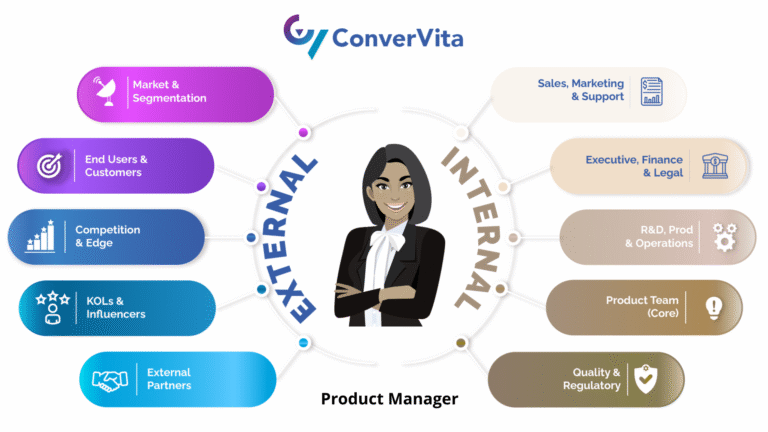
The underestimated role of the Product Manager
Too often, the Product Manager (PM) role is misunderstood or underestimated. Many think it’s about managing a roadmap or writing requirements, but in reality, it’s much more.
A PM needs to maintain a 360° vision of everything happening inside and outside the company regarding the product. Why? Because the product is the lifeblood of the company. It’s what drives growth, competitiveness, and customer value.
Being a PM means constantly navigating between:
- Innovation & the future (anticipating trends, technology maturity, market positioning)
- Day-to-day urgencies (customer requests, bugs, quick wins)
- Cross-functional discussions with R&D, marketing, sales, finance, quality, operations…
- Customer and market insights (end users, competition, influencers, partners)
At the same time, PMs must ensure the roadmap is respected, the strategy is aligned, and the product delivers real value to the market. It’s a role at the intersection of vision, execution, and communication. It requires a unique blend of strategic thinking, pragmatism, and empathy. This is why at ConverVita, we believe in strengthening the PM function, because a strong Product Management culture is the key to sustainable innovation and growth.
Market: Life sciences / Instrumentations
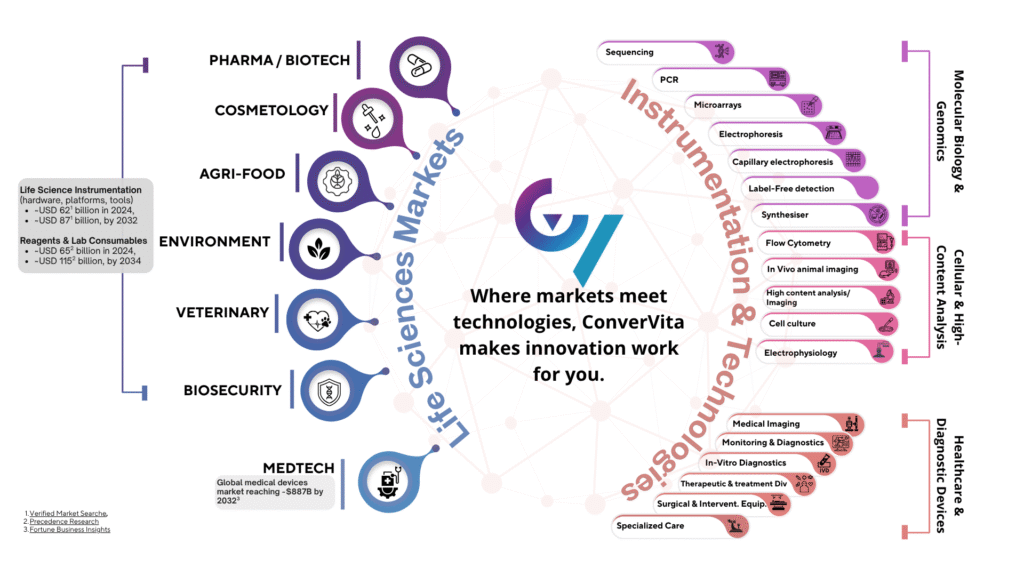
Where Markets Meet Technologies
In the Life Sciences sector, innovation only happens when technologies truly meet real market needs.
Yet this intersection, between scientific potential, user expectations, and regulatory constraints, is often complex, fragmented, and poorly mapped.
Technologies evolve faster than the markets they serve, while markets diversify faster than organizations can adapt. Understanding this dynamic requires more than data, it demands a systemic view of how applications, instruments, and value chains intertwine.
That’s where ConverVita steps in.
We help Product Managers and decision-makers navigate this complexity, turning scientific capability and market diversity into clear strategic direction.
- Understanding the Market Landscape
The Life Sciences market is broad, interconnected, and often confusingly segmented. Boundaries between fields are not always clear, and that matters for how you define opportunities, competitors, and positioning.
For instance, MedTech is sometimes treated as a separate industry, yet it fully belongs within Life Sciences. Only distinguished by its regulatory framework and healthcare orientation.
Other sectors overlap even more: Veterinary lies at the crossroads of Pharma, Agri-Food, and MedTech, while Biosecurity touches both public health and environmental safety.
At ConverVita, we decode these intersections, helping you clarify:
- Where your product really fits in the market,
- Who your true competitors and customers are,
- And which segments hold the highest potential for your strategy.
- Decoding Instrumentation & Technologies
Behind every innovation lies a hybrid system of technologies. In Life Sciences, few instruments rely on a single domain. They are born from the convergence of optics, microfluidics, electronics, mechanics, and software.
A product is never just an instrument. It’s an ecosystem of:
- Hardware (instrument architecture, sensors, flow systems)
- Software (control, analysis, data visualization, connectivity)
- Consumables (reagent kits, cartridges, chips, slides)
- Integration layers ensuring regulatory compliance and user experience.
Understanding this interdependence is essential to prioritize what drives value, differentiation, and scalability.
At ConverVita, we help Product Managers map these technology layers, from scientific core to business impact. And connect them with the right market opportunities.
Our approach combines market intelligence, technology mapping, and strategic framing to make innovation actionable.
We don’t just analyze; we help teams see the bigger picture: how each component, regulation, or partnership fits into the larger system of innovation.
Because great Product Management starts where markets and technologies converge, and where clarity creates impact.